Pages

Tuesday, 21 October 2014

New name....


Back in March 2014 the Mid-Kent and East Kent groups merged to become one.  A successful merger where both groups were able to keep up the standards we all aim for, to deliver Advanced Motoring courses to the standard of the IAM. This week it's been announced that Mid-Kent Groupd of Advanced Motorists will change its name to Kent Group of Advanced Motorists. We will still be able to meet the standard expected and since we cover the whole of Kent, it certainly makes sense. Our Chairman Linda Davies released a statement on our new site.

With this news our Website and Social Media Co-Ordinator Graham Aylard has been busy creating a new look website, containing all the information and inspiration to attract new members and those wanting to improve their driving. Not to leave anyone out, our current members and observers will also find our new website useful too, with information about our events throughout the year. 


The new website can be found at: 

www.kentiam.org.uk. 


Our blog will also move. This will contain motoring related news, and advice and tips of the motoring nature. We'll also be posting congratulations messages when associates pass their Advanced Motoring test. 


Our new blog can be found at 

http://kent-iam.blogspot.co.uk

Our Facebook and Twitter pages has also undergone the change and we'll be posting all sorts of motoring related information, driving tips and road related safety advice. Twitter will be updated regularly several times a week. 


This is the last post here on this blog.  Please take a look at our new look website and new look blog (links above) and feel free to post your comments here or if you wish email the Website and Social Media Co-ordinator Graham Aylard.

Thursday, 9 October 2014

Don't cry on the hard shoulder!!

Nobody wants to be left stranded on the hard shoulder, but if you don't take care of your car there's every possibility you will be. Here are the latest IAM tips to guide you through looking after your car, because basic maintenance goes a long way.

Charged battery

A flat battery is one of the most common reasons for a breakdown, so make sure your car battery is properly secured with a clamp in the battery tray, because a loose battery can damage the delicate lead plates. To ensure the battery is charged up, the fan belt needs to be tight. So if you hear a screeching noise after you start the engine you will need to tighten the belt or possibly replace it.

Drivers commuting short distances who use their lights and heater can drain out the battery power. However a longer drive will recharge it fully and give the car a good workout. Ensure the top of your battery is kept clean and dry to stop charge leaking away. Do bear in mind that the car battery will wear out, so be prepared to replace it if it goes flat or is more than five years old.

Coolant level

Water for the radiator must be mixed with the right type of anti-freeze all year round to stop corrosion inside the engine – a common cause of blown head gaskets. Make sure you check the level weekly when the engine is cold. If you find you are topping up far too often, this may be a sign of a leak that needs to be fixed by a mechanic.

Anti-freeze

The first sub-zero day of autumn brings a flurry of frozen engines, caused by too little anti-freeze.  Check you have enough frost protection by removing the filler cap. Siphon a little coolant into a small container and put it in your freezer overnight.  If it freezes, you need more antifreeze.

Oil checks

When you check your oil, it's important to be on a level ground. It's not unusual for modern engines to use a little oil – some are designed that way – but a sudden increase in oil consumption is a sign that there's a problem.  It's also important to use the correct oil for topping up, so make sure the oil you use meets the requirements listed in the owner's handbook.  Blown turbo chargers and broken timing chains are possible results of using the wrong oil.

Brake fluid

Modern cars will have a warning light to alert you of a low fluid level, but it's still worth taking a look at the reservoir while you're checking the other things under the bonnet.  The level will drop slightly as the brakes wear down, but it should not fall so low that it needs topping up. When new brakes are fitted, the fluid will return to the full level.  If the level has dropped below the minimum, the warning light should come on; get the brakes checked because there may be a fluid leak.

Tuesday, 7 October 2014

More than 60 drivers caught snapping accident on phones

Man stabbed after confronting group

Rubbernecking is nothing new. A build-up of traffic often occurs on the opposite side of an accident purely because humans find it extremely difficult not to indulge their dark side and cop a good look at the carnage.

But police have decided to draw the line on motorists who insist on photographing the scene of an accident with their mobile phones.

An accident that saw an overturned lorry spill its load over the A34 at Sutton Scotney, Hampshire, last week resulted in a staggering 60 drivers receiving a letter asking if they were driving at the time a photograph of the scene was snapped.

Police officers recorded the number plates of the offending vehicles and plan to punish those reckless enough to reach for their mobiles and take a picture.

If the drivers were found to be using a mobile phone at the wheel, they could be fined £100 and given three penalty points, or offered a driver awareness course, police revealed.

An unnamed passenger who admitted to taking a photo of the scene told the BBC: "If you're hanging out the window with your camera phone then you're asking for it.

"There were not any police around when I went past. If people were stationary, what harm are they doing?"

But the law clearly states that drivers are only allowed to use their mobile phones in the car when they need to call 999 or 112 in an emergency when it's unsafe or impractical to stop, or when the vehicle is safely parked.

Nick Lloyd, from the Royal Society for the Prevention of Accidents, commended the police for taking such positive action against offending drivers but said, "it's very disappointing they have to do this in the first place, that 60 drivers have been seen taking a photograph,"

Sunday, 5 October 2014

Congratulations - well done!!


TEST PASSES
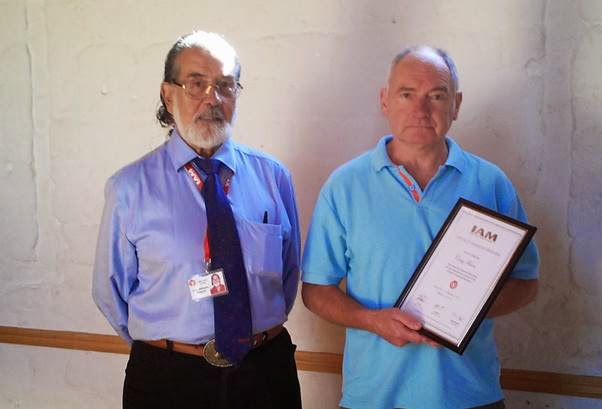
Congratulations to Craig Fearn with Observer Alan Billington

and also to Ken Schneider with Observer Mark Ashman

Thursday, 2 October 2014

Use of Fog Lights

Do you know the Highway Code guidance around the use of fog lights?

If, upon seeing the first signs of mist in the air, you reach for the button on the dashboard then you may want to dust off your copy of the Highway Code.  According to Rule 226 you "must use headlights when visibility is seriously reduced, generally when you cannot see for more than 100m (328 ft). You may also use front and rear fog lights."  There is no hard and fast rule that states when it is misty/foggy, you should use fog lights - this is left to the driver and is a subjective decision.
These two images, taken at the same location clearly shows the reduced visibility the fog has. Although not thick fog, you can clearly see the cream building ahead in the right hand picture, but not in the left. 

However, having assessed the conditions and decided that fog lights are necessary, there are some definite things which you should do.  Firstly, increase the gap between yourself and the car in front.  Whilst this may seem counter-intuitive - after all, given that visibility has been reduced doesn't it make sense to close in other cars so that you can see them - by increasing the gap between you and the car in front you are giving yourself a safety cushion.  You do not know how observant the other driver is and, if they do not see something and have to react at the last minute, you want time to bring your vehicle to a stop safely whilst also managing the car following you so a multiple pile up is avoided.

Secondly, be aware that driving long distances with limited visibility can be tiring.  You will therefore need to plan more breaks than you might have initially anticipated and allow time for your eyes to recover from the strain you're placing on them.

Remember the Sheppey Crossing incident
last year? 130 vehicle pileup happened
in the fog. But was it solely the fault of
the weather?
Thirdly, do not assume that just because you can see no lights that there is nothing there.  Whilst you have been conscientious and used your fog lights (or dipped headlights if visibility is impaired but not less than 100m), not all road users are as good as you are!  As an ex-driving instructor of mine used to say "treat everyone else as a fool and you'll seldom be disappointed".  Therefore, before proceeding at any junction or hazard, take time to double-check and consider winding down your window to listen for engine noise.  Sound can often carry better in fog and this will give you some early indications that you're not alone!

Finally, once the fog has cleared, remember to turn off your fog lights.

Some top tips:


  • When in traffic consider turning off rear fog lights.  They are designed to improve your visibility to other road users and continual exposure at close range may dazzle the driver behind and mask your brake lights (thereby potentially causing a rear end shunt).
  • Do not keep turning them on and off when going through patchy fog - make a decision and stick to it.  Flickering lights will be more of a distraction to following cars than the potential dazzle.
  • Only use fog lights if visibility is below the recommended 100m and, when they are used, slow down as well.


Post written by Neil Lakeland, Observer with the Mid-Kent Group of Advanced Motorists.


If you wish to know more about Advanced Motoring or wish to join us and become an Advanced Motorist, please vista out website for all the details.

Thursday, 25 September 2014

89-year-old former racer's Porsche pass

Former Yorkshire motocross champion, Philip Green has been praised for his outstanding driving performance after completing one of our IAM driving assessments in his Porsche 911.
 
Despite having over 50 years' experience in both driving and riding, the spirited 89-year-old undertook the IAM assessment to gain more confidence behind the wheel, in which an IAM approved assessor evaluated his driving performance. While the assessment is designed to give older drivers a trusted second opinion, Philip urged other drivers to take an IAM driving assessment to gain a sense of self-satisfaction.
 
Assessed across a variety of roads and dual-carriageways IAM examiner, Ross Williams said: "Philip's hazard perception skills are highly commendable. He handled the vehicle very well and demonstrated the ability to make all adjustments in speed smoothly and steadily".
 
Having owned more than 10 performance cars over the last 30 years, Philip added: "There's a real misconception that not everyone can drive a Porsche, but they're not at all fiery or fast – unless you want them to be. I drive my Porsche every day and it is a safe vehicle".
 
IAM director of policy and research Neil Greig said: "We understand the need for mobility and independence at all ages – and how much people want or need to drive. Philip Green is a fine example of what older drivers can do if they don't give up too early. That's why we've developed a number of driving assessments, including a Mature Driver's Assessment – so that the likes of Philip can happily continue driving his Porsche for many more years".

Wednesday, 24 September 2014

Don't let the dazzling sun tamper your journey - advice from the IAM

Low sun can impact your driving, making it difficult to see other things or people on the road. With our latest tips, however, you can find the best ways possible to make your journey safe.

When it's low take it slow

Too much bright light can be as effective at stopping you see things as too little – but you must still be able to stop within the distance you can see to be clear.  If low sun is affecting your ability to see clearly then slow down. Don't feel the need to increase your speed if a vehicle is tailgating behind you and slow down as you approach areas like sharp bends or experience changes in light level where others may be harder to see. 

Sunglasses at the ready

A sun visor doesn't necessarily stop low sun from beaming into your windscreen, so wear sunglasses. Keep a pair handy in the car so you can wear them when you need to – but remember to take them off if you go into a darker area, like the shade of trees.

Switch them on

When driving before sunset always switch on your headlights so other drivers can see you. The same applies for driving after sunrise where you should keep your headlights switched on until the light level really gets up.

Dip them low

When the sun is beaming into your car from the rear window, it will often dazzle you via your mirrors. In such cases, be prepared to dip your mirrors and check over your shoulder to see vehicles in your blind spot. 

Wash them clean

Dirt and grime are often highlighted on your windscreen when you are driving in low sun. To ensure this does not obstruct your vision make sure your washer bottle is filled with a good quality screen washer liquid so you can wash away any deposits and clear the streaks.

Avoid direct gazing

Try and avoid looking directly at the sun as this will impact what you can see on the road. Low and sharp sun rays can make your eyes feel blurry and hazy – if you experience this when you are driving then take a break from your journey until you can see clearly again.

Tuesday, 23 September 2014

The road network in England is to be extended by 900 miles

road paving
The road network in England is to see 900 miles of new carriageways added to it, in what the government has said is the largest road transport investment since the 1970s.

A total of £24 billion is being ploughed into developments on motorways and major A roads, with the aim of creating greater traffic capacity (by a third) in the face of rapidly increasing car ownership.

In total, 60 separate new road schemes have been committed to, which will create 962 miles of new roads, according to roads minister John Hayes. Most are intended to relieve traffic blackspots and bottlenecks in the current network. Possible solutions are expected to be published later this year.

Mr Hayes commented: "This government will oversee more work, more safety, and more improvements on our roads. This will benefit hard-working people and businesses, help ease congestion and create a road network fit for the 21st century and beyond."

Motorists who have suffered damage to their cars as a result of the poor state of roads will be pleased to hear than £6 billion of the total budget has been earmarked to resurface more than 3,000 miles of the network.

The government is claiming to have taken the concerns of green campaigners and environmental groups into account in the planning of this new investment, with the expansion of existing roads, rather than the creation of new ones, key to reducing the scheme's ecological impact.

"We're doing this with great care for our environment. This extra capacity will be achieved mainly by the use of smart motorways and selective widening to minimise the environmental impact," Mr Hayes explained.

The investment will be shaped by the results of the Highways Agency's route strategies – a comprehensive review of all the country's roads, which will determine future roads management priorities.

The Highways Agency itself is also due to be turned into a government-owned company, a move that is hoped will save taxpayers around £2.6 billion over the next ten years.

Black boxes set to become more intrusive

Car insurance premiums fall sharply
In-car black boxes can already monitor your driving habits, but telematics systems could soon start hanging up your phone and turning down your radio, as use of this technology becomes more widespread – and more invasive.

Experts have predicted that every British driver could be monitored by their insurer's spying technology over the next 10 years, reports the Telegraph. Drivers who refuse to have black boxes fitted to their cars could see increased insurance premiums or be refused cover completely.

Many younger drivers are already forced into using black box systems, as premiums rocket if they refuse to have kit fitted to their car to monitor their speed and driving habits. Over 300,000 cars have already been fitted with such devices, which can keep track of drivers' speed, braking, steering inputs and the mileage they cover.

The extent of monitoring technology could even extend to intelligent windscreen wipers to keep tabs on the weather, as insurers try to gather ever more information on the conditions that lead up to a crash. With the development of new technologies, experts are predicting that the number of ways drivers are watched, could increase.

New technology could allow insurers to spy on drivers' mobile phone use and monitor if they send any texts while driving. A spokesperson from price comparison sitecomparethemarket.com told the Telegraph: "The technology can track literally anything that is in the car – it just depends on what data the insurer wants to analyse. The number of text messages a driver sends while behind the wheel can be monitored, which insurers could use against a driver who frequently texts."

Distraction is one of the main causes of car crashes, and several insurers are believed to be considering developing black boxes which can monitor the sound levels of all devices within the car. A researcher at Thatcham, an insurance research centre has stated that black boxes could potentially disconnect in-car phone calls and turn off sound systems over certain speeds.

Devices which can silence the driver's phone or limit the volume of the radio have already been developed, while others already keep check of the times when the car is used.

Would you use a telematics system that monitored your every move in return for vastly reduced insurance rates? What do you think?

Tuesday, 16 September 2014

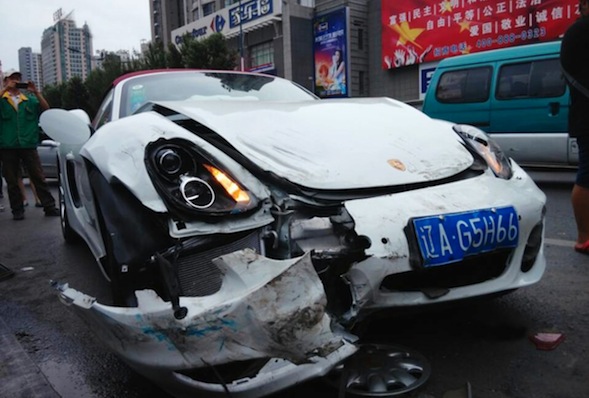
Woman totals brand new Porsche seconds after taking delivery

Crashed Porsche Boxster
It's a well-known fact that a brand new car sheds thousands of pounds in value the minute it's driven off the forecourt. One Chinese motorist, however, lost considerably more than she bargained for after she crashed her brand new Porsche, just seconds after leaving the dealership.

Taking delivery of her Porsche Boxster, which starts from £38,810 in UK dealerships, the lady immediately caused an estimated £150,000 worth of damage after getting the throttle and brake pedals mixed up, as she joined traffic in Shenyang, north east China.

The 27-year-old was spotted accelerating into the back of a queue of cars waiting at a set of traffic lights.

A witness said: "She seemed to be trying to change lanes when without warning she shot forwards.

A Porsche salesman commented: "We were still waving her goodbye when she shot forward and there was a tremendous bang."  "We all ran over and she wasn't hurt but the car was a real mess. We pushed it back to the showroom where it is with the mechanics.  "We'd warned her that it was a very powerful car."

A police spokesman later confirmed that they were not seeking anyone else in connection with the accident, and that she would be held liable for all the damage caused.

The Porsche Boxster is the German brand's most affordable sports car, but will still accelerate from 0-62mph in 5.8 seconds and reach a top speed of 164mph, thanks to a 261bhp 2.7-litre six-cylinder engine.

Furious motorist fires car off back of tow truck

Motorist drives car off lorry
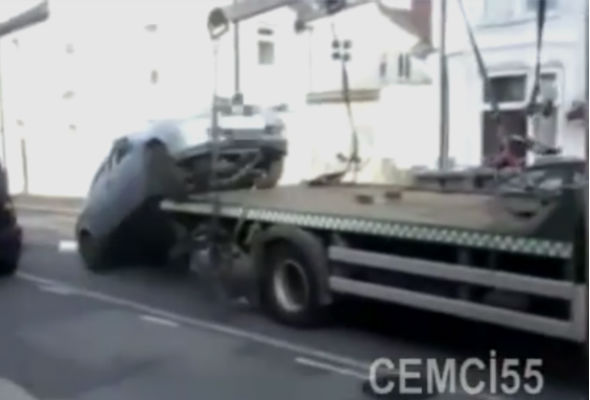
It's sod's law: you come back to your car the second a parking warden is watching it being loaded onto the back of a lorry. Game over. However, the driver in the clip below wasn't quite ready to watch his Vauxhall Astra being towed into the distance at this stage.

Instead, the furious motorist, who had parked illegally in Walthamstow, east London, clambered onto the back of the lorry, jumped into the driver's seat of his car, revved the engine and launched it off the back of the flatbed. In reverse.

Dropping around three feet to the ground the car lands with a clunk but seems to survive intact, bar a slightly battered exhaust. The driver then reversed off, as the Waltham Forest Council parking attendant who was filming the footage, watched on, no doubt stunned by what they had just seen.

A passerby said "'There was an almighty crash as he dropped about three feet to the ground - I would think that whatever money he saved on the parking ticket, he'll have to pay to get his exhaust repaired."

The parking firm reported the incident to the Metropolitan Police though the police have said the matter is a "civil dispute". Waltham Forest Council has since been unable to trace the driver.

Wednesday, 10 September 2014

Proportion of women caught drink-driving nearly doubles

Drink-drive survey
The number of women convicted for drink-driving almost doubled over a 14-year period, a survey has revealed. This research has discovered that 17 per cent of those who were caught drink-driving were women in 2012, compared with just nine per cent of the total back in 1998

The survey carried found that 17 per cent of female drivers also believed that they had driven while over the drink-driving limit within the last year.

Six out of 10 of the women surveyed admitted that they were unaware of the legal limit for drink-driving. Furthermore, nearly all of the respondents claimed that they were able to drink more alcohol than the "average woman" before being over the legal limit.

Of those who admitted to drink-driving, the most common justification – cited by 59 per cent of respondents – was that they felt "okay" to drive. Meanwhile, 31 per cent thought that they'd be safe if they drove carefully and 17 per cent didn't feel they had any alternative – often because of "family emergencies".

Surprisingly, 14 per cent also said that they were happy to drive while over the limit as they didn't think there was much chance of being caught.  it was a "common scenario for a woman to be designated the driver after a dinner party and to underestimate the effects of alcohol they've consumed",

Minister for road safety Robert Goodwill said: "Drink-driving wrecks lives, and the personal consequences of a drink-drive conviction can be devastating. In 2013, 803 women failed a breathalyser test after an accident and that is 803 too many.

"That is why we are cracking down on the minority who drink and drive by introducing a new offence of causing serious injury by dangerous driving and closing loopholes in the law to make it easier for police to prosecute drink-drivers."